
About the Journal
BORASPATI Journal: Bilingualism, Organization, Research, Articles, Studies in Pedagogy, Anthropology, Theory, and Indigenous Cultures is a peer-reviewed, interdisciplinary open-access journal dedicated to the advancement of knowledge in language, education, literature, and cultural studies. We provide a high-quality platform for researchers, educators, and practitioners to disseminate original research that bridges theoretical frameworks with practical applications.
In formal collaboration with the Faculty of Teacher Training and Education at Universitas Sisingamangaraja XII Tapanuli, BORASPATI Journal places a strategic emphasis on cultural preservation and educational innovation. While we have a strong root in the study of Batak local wisdom and regional linguistics, the journal welcomes comparative studies and diverse perspectives on indigenous communities worldwide. Our scope includes, but is not limited to, culturally-based learning models, digitalization of regional literature, and the sociolinguistics of indigenous languages.
Rigorous Editorial Process To ensure scientific integrity, all submissions undergo a strict double-blind peer-review process. BORASPATI Journal is committed to a transparent and efficient editorial workflow, with an average publication cycle of 8 weeks from initial submission to final online release. We adhere to high ethical standards in publishing to ensure that every article contributes significantly to the global academic discourse.
| Journal Title |
: Bilingualism, Organization, Research, Articles, Studies in Pedagogy, Anthropology, Theory, and Indigenous Cultures |
| Initials | : BORASPATI JOURNAL |
| Frequency | : February - Juni - October |
| Doi Prefix | : 10.64616/boraspatijournal |
| Chief Editor | : Kaleb E. Simanungkalit, M.Pd. |
| INDEKS |
: GARUDA | GOOGLE SCHOLAR |Indonesian One Search | Base | Scilit |Dimensions |
| Publisher | : PT. Batak Story Pedia |
| Address | : Marcopolo Residence Blok. B. No. 16, Simalingkar B, Kec. Medan Tuntungan, Kota Medan, Sumatera Utara, 20134. |
 |
 |
 |
 |
 |
 |
 |
 |
 |
 |
 |
 |
 |
 |
 |
 |
 |
 |
 |
 |
Current Issue
Vol. 3 No. 1 (2026): VOLUME 3 NUMBER 1 OKTOBER 2026
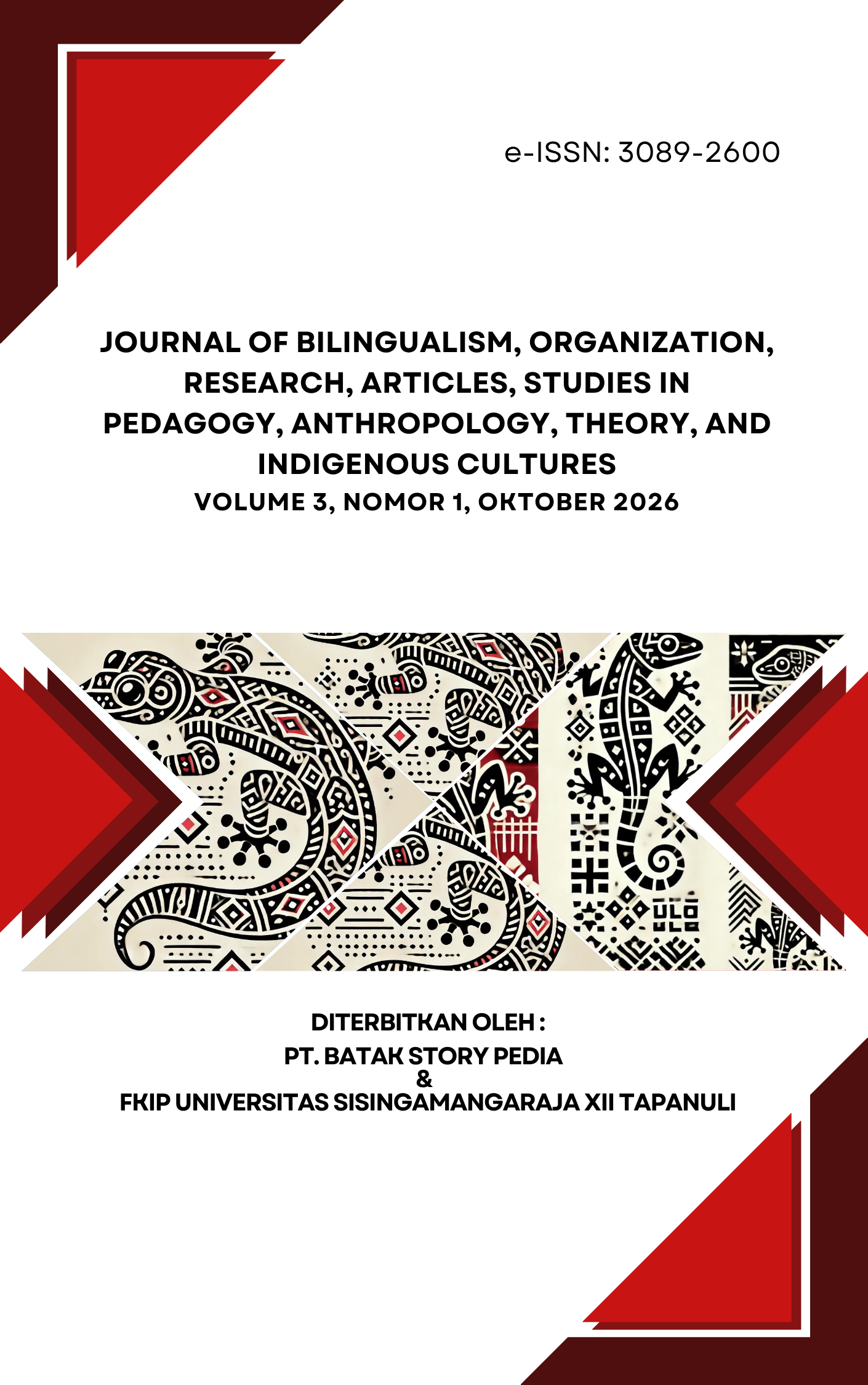
Volume 3, Issue 1 (October 2026)
BORASPATI Journal Volume 3, Issue 1 (October 2026) presents a collection of peer-reviewed research articles that contribute to the advancement of interdisciplinary scholarship in linguistics, language education, literature, cultural studies, and indigenous knowledge systems. The articles published in this issue reflect the journal's commitment to promoting high-quality academic research that bridges theoretical perspectives with practical applications in addressing contemporary educational, linguistic, and sociocultural challenges.
This issue features original studies covering instructional innovation, culturally responsive pedagogy, theoretical and applied linguistics, multilingualism, language policy, literary studies, digital humanities, and the preservation of indigenous languages and cultural heritage. The published works also highlight the integration of local wisdom into educational practices, the digitalization of regional literary resources, and research-driven approaches to strengthening community engagement and sustainable cultural development.
Volume 3, Issue 1 (October 2026) includes manuscripts that were accepted for publication between July and October 2026. All accepted manuscripts successfully completed the journal's editorial process, including initial screening, plagiarism checking, rigorous double-blind peer review, author revisions, and final editorial evaluation before publication.
As an interdisciplinary, peer-reviewed, and open-access journal, BORASPATI Journal continues to serve as an international platform for researchers, educators, practitioners, and policymakers to disseminate innovative research and exchange scholarly perspectives. Every manuscript included in this issue has undergone a rigorous double-blind peer-review process to ensure scientific quality, originality, ethical integrity, and academic significance.
We hope that the articles published in Volume 3, Issue 1 (October 2026) will enrich global scholarly discourse, encourage interdisciplinary collaboration, and inspire future research in linguistics, language education, literature, anthropology, and indigenous cultural studies.
Published:
2026-07-16
Articles
-
Analisis Struktur dan Jenis Kalimat pada Podcast Raditya Dika An Analysis of Sentence Structure and Sentence Types in Raditya Dika's Podcast
- PDF | Views: 158 times | Download : 92 times


